How to Stop Snacking at Night (Without Banning Snacks)
You eat normally all day. Then it's 10 PM, the kitchen is quiet, and you're standing in front of the fridge — not hungry, exactly, but definitely going in. If that sounds familiar, this article is for you.
Here's the short version: you can stop snacking at night without banning snacks, counting calories, or “being more disciplined.” The most reliable method is delaying — telling yourself “not yet” instead of “no” — because most cravings fade on their own within 10–20 minutes if you don't feed them and don't fight them.
The rest of this article explains why bans backfire, how the delay technique works, and exactly how to run it tonight.
Why you can't stop snacking at night (it's not willpower)
Night snacking is rarely about hunger. By evening, three things stack against you: your self-control is depleted from a full day of decisions, your routines dissolve (no meetings, no structure — just you and the kitchen), and eating has quietly become your wind-down ritual. You're not weak at 10 PM. You're unstructured at 10 PM.
That's why generic advice like “just brush your teeth earlier” or “remove all snacks from your house” tends to fail. It treats the symptom (food is nearby) instead of the actual mechanic (an urge shows up and you have no protocol for it).
Why banning snacks makes night cravings worse
Restriction amplifies cravings instead of removing them. Decades of research on dietary restraint show that people who label foods as forbidden think about those foods more, crave them harder, and are more likely to overeat them once they finally give in — the “what-the-hell effect” described by researchers Janet Polivy and C. Peter Herman. One broken rule and the whole evening collapses into “well, I've already ruined it.”
A ban also turns every evening into a fight. And fights with your own brain are exhausting — you can win Monday through Thursday and still lose the whole week on Friday night.
So the goal isn't to never want a snack. The goal is to change what happens between the urge and the fridge.
The delay technique: say “not yet” instead of “no”
The delay technique works like this: when a craving hits, you don't refuse it — you postpone it. “I can have this in 15 minutes if I still want it.” Then you do literally anything else. In most cases, the craving fades before the timer does — and if it doesn't, you eat the snack deliberately, without guilt.
Why does this work when willpower doesn't?
Cravings behave like waves. They build, peak, and subside — usually within 10–20 minutes — if you neither feed them nor wrestle with them. This is the core insight behind urge surfing, a technique from mindfulness-based relapse prevention developed by psychologist Alan Marlatt. In a randomized study by Sarah Bowen and Marlatt (2009), smokers who were taught to observe and ride out their urges — rather than suppress them — smoked significantly less over the following week than a control group. The urge itself wasn't the problem. Reacting to it instantly was.
Delay exploits the wave. “No” tries to block the wave head-on and gets crushed by it. “Not yet” just… waits for it to pass. And crucially, “not yet” doesn't trigger the rebellion that “never” does — your brain doesn't fight a postponement the way it fights a prohibition.
There's a second benefit: delay is a filter, not a test. If the urge survives 15 minutes, that's real information — maybe you're genuinely hungry, or the day was rough and this cookie is the correct decision. Eat it. Deliberately choosing a snack after a delay is a completely different act than autopiloting into the fridge. One builds trust with yourself; the other erodes it.
How to stop night snacking with the delay method (step by step)
- Notice the urge and name it. “That's a craving” — said out loud or in your head. This tiny step moves you from autopilot to observer, which is where all the leverage is.
- Set a delay: 10–15 minutes. Phone timer works fine. The number matters less than the commitment — you're not deciding no, you're deciding later.
- Occupy your hands, not just your mind. Make tea, tidy one shelf, step onto the balcony, stretch. Cravings feed on idle hands in the kitchen. Don't try to white-knuckle it on the couch while staring at the clock.
- When the timer ends, decide consciously. Still want it? Eat it — sitting down, paying attention, zero guilt. Don't want it anymore? Notice that. That's the wave passing, and every time you watch it pass, the next wave gets smaller.
- Track the pattern, not the calories. After a week, you'll see it: which evenings trigger you (stress? boredom? that one show?), and how often the craving actually survived the delay. For most people it's a minority of the time — which is the most motivating statistic you'll ever collect about yourself, because it's yours.
Two ground rules that keep this sustainable: never stack a delay on top of real hunger (if you skipped dinner, eat dinner — delay is for impulses, not for starving yourself), and never punish a “failed” delay. There is no failed delay. You either watched the wave pass or you made a conscious choice. Both are wins over autopilot.
Why I built an app around this
I used this exact method with a phone timer for months — and kept hitting the same friction: the timer knows nothing. It doesn't know what I was craving, doesn't remember that Tuesday nights are my danger zone, and a kitchen timer going off feels like an alarm, not a decision point.
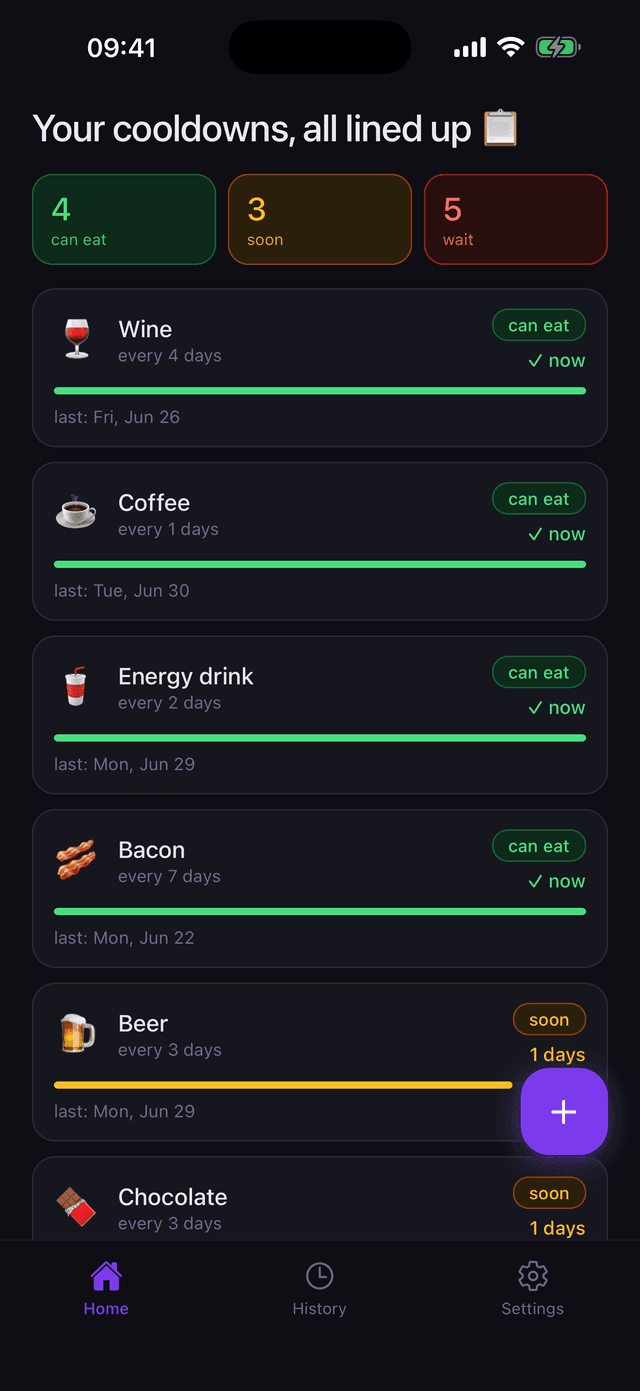
So I built NotYet — a small iOS app that does one thing: when a craving hits, you log it and start a delay. When time's up, you decide. No calorie counting, no streaks to break, no red warning screens when you eat the snack. Your data stays on your phone. It's the timer method, minus the friction — built by someone who uses it every single evening.
FAQ: night snacking and the delay method
Does the 10-minute rule actually work for cravings?
Yes, for most impulse-driven cravings. Urges typically peak and fade within 10–20 minutes when you don't act on them or suppress them — the mechanism behind urge surfing, which reduced smoking in a controlled study (Bowen & Marlatt, 2009). It won't erase real hunger, and it shouldn't: delay is a filter for impulses, not a restriction tool.
Why do I only crave junk food at night?
Because evenings combine depleted self-control, dissolved structure, and learned ritual. After a day of decisions your restraint is at its lowest, there's no external schedule keeping you busy, and if you've unwound with snacks before, your brain now expects them as part of the routine. The craving is a habit loop firing, not a nutritional need.
Is delaying eating the same as intermittent fasting?
No. Intermittent fasting is a restriction schedule — fixed windows when eating is not allowed. Delaying is the opposite of restriction: nothing is forbidden and there are no windows. You postpone a single impulse by a few minutes and then choose freely. If fasting rules have backfired on you before, delay is specifically designed not to.
What if I still want the snack after the delay?
Eat it — that's the system working, not failing. A craving that survives 15 minutes is information: real hunger, a hard day, or a snack that's simply worth it. Eating it as a conscious decision, sitting down and paying attention, is a fundamentally different behavior from autopilot grazing. The goal was never zero snacks; it's zero mindless snacks.
When is night eating a sign of something more serious?
If eating feels out of control, involves regular binges, significant distress, or waking up at night to eat, that may point to binge eating disorder or night eating syndrome — and a self-help technique isn't the right tool. Please talk to a doctor or a therapist who works with eating behaviors. This article (and the app) are built for everyday impulse snacking, not for treating an eating disorder.
Written by Mateusz Penkala, indie iOS developer and the builder of NotYet. I use the delay method daily — this article describes what I do, not theory.